Apple in China by Patrick McGee
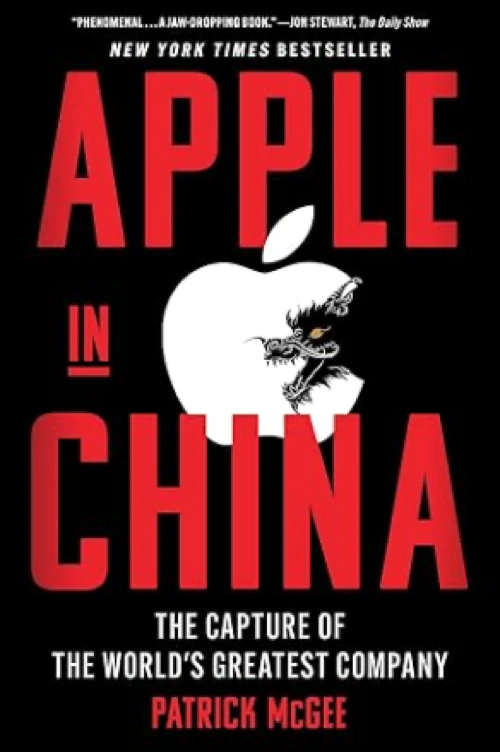
I read this book because I wanted a deeper understanding on how Apple build its production operations in China. Also, I had heard Ben Thompson interviewing Patrick McGee in Stratechery, so I got curious about the Chinese government coaxing Apple into transferring technology and training thousands of people over the years.
It’s frequent to hear people critique Apple leadership for not being innovative enough, or how Steve Jobs would have done things differently. I always find these arguments shallow and unconvincing. Apple may not be the innovative company people want to see. But building successful products at Apple’s scale takes a kind of innovation that is often overlooked.
McGee describes a process that was repeated for each of Apple’s products during the years after Jobs’ return to the company:
- The Industrial Design Team (ID), led by Jony Ive, would spec an incredibly beautiful—and often impossible to manufacture—product.
- The Product Design Team spent days and nights trying to come up with a way to convert the design into reality. The task that many times seemed impossible. When Steve Jobs was alive, he wouldn’t accept a no for an answer, so the team kept trying until they achieved what seemed impossible.
- Then the product had to be produced at scale and efficiently.
The Product Design Team had enormous pressure. For example, writes McGee, Jobs and Ive wanted the case of the first iPhone to be 100% metal. They didn’t care that the antenna specialists at Apple told them that it was impossible for the cellular signal to go through the metal case.
For the first iPhone models, Jobs had to reluctantly accept a small plastic strip on the case. But he kept pushing his point. Finally, after some years, Apple came up with a novel solution: the antennas were integrated into the metal frame/band that runs around the sides of the phone. Different sections handle different signals: cellular, WiFi, Bluetooth, GPS, NFC, Ultra Wideband. This innovation was quickly adopted across the smartphone industry.
The actual production of Apple products at scale also presented incredible challenges. Apple was always pushing what could be done, so many times they used custom-made components. Also, assembling the actual components represented a challenge by itself.
For several years Apple relied on different contractors around the world for the assembly of their product line. However, as Apple products became more successful and production volumes increased, their partners started to fail.
The solution to these scaling challenges came from an unlikely partnership. Enter Foxconn’s founder Terry Gou. Gou was an ambitious and driven Taiwanese entrepreneur based in China. He started designing and producing connectors for chips and other electronic pieces at scale. Four main points about Gou:
-
He quickly saw the opportunity in forward integrating his business into manufacturing and assembling of finished products.
-
He understood from the start that Apple was not only looking for cost efficiencies. While other companies selling electronic products associated China with low costs, Apple saw in China the opportunity to push what was possible to manufacture.
-
Gou also understood that working with Apple put Foxconn in a privileged position:
Gou grasped earlier than anyone that the value of working with Apple wasn’t the profits, it was the learning. Foxconn might not win much profit from Apple—it might even lose money at times—but the work itself, as well as the lessons Cupertino offered by having its engineers work side by side with locals in the factories, gave his team a deep education. Foxconn’s goal was to absorb these lessons and apply the skills to its other, more lucrative clients.
- Finally, while Apple was at a total loss—even worse, they weren’t aware—when it came to how China functioned, Gou understood the Chinese Government and the local authorities. He understood the Chinese Party determination on economic growth, where the incentives for local bureaucrats lay, and how to align those interests with his clients needs. He could obtain co-financing for factories and land at ridiculously low prices. He also knew how far he could push his labor force while the authorities turned a blind eye.
Through the book, one becomes impressed with Apple’s excellence at manufacturing at scale. Yet this manufacturing excellence came at a disturbing human cost. The book depicts an Apple whose top executives are sociopaths obsessed with pushing the limits of people at any cost while it didn’t break legal boundaries.
For example:
[Apple’s] Engineers said the pressure to put in the long hours was all but mandatory. Indeed, a decade later after Jobs created Apple University, a corporate institution meant to convey his values to a new generation of employees, Apple came close to codifying the principle that pushing employees to burnout was acceptable. In a slide deck called Leadership Palette, Apple states: “Fighting for excellence is about resisting the gravitational pull of mediocrity. It involves being dead tired and still pushing yourself, and others, to get it right, every time.”
At Apple, eighty-hour workweeks were normal. Many employees had to fly to Asia to oversee operations or solve a problem with little warning and for unknown durations. Employees’ health and marriages suffered. Most of them being men, their wives started calling themselves the “Apple Widows.” Also, a lot of people got sick, some fatally so.
While it’s not possible to conclude that overwork was their cause of death, many believe it was. One longtime veteran recalls that, during the funeral for one of these people, the number of Apple employees who left the Sunday service to join conference calls was unbelievable. According to Walter Isaacson, Jobs even attributed his own cancer to the volume of work he’d taken on in 1997. That’s when he was running both Apple and Pixar, developing kidney stones, and coming home so exhausted that he had trouble speaking. “That’s probably when this cancer started growing,” Jobs told his biographer.
And let’s not delve into how Apple partners in China treated their employees. Imagine the worst, you’ll probably fall short. If you think Apple has changed, at the end of the book McGee explains how in the effort to diversify production to India, Apple and Foxconn lobbied for a landmark bill in the Indian state of Karnataka to allow factories to run twelve-hour shifts, up from nine hours previously.
So yes, Steve Jobs was a genius. But also a ruthless asshole who saw people as means to an end. And people who helped him and were complicit fell in the same category. Many still are at Apple leadership.
Apple didn’t understand China. Despite their manufacturing sophistication, Apple fundamentally misread the Chinese political landscape.
For example, they didn’t realize that the company’s public efforts in the US for better conditions for Chinese workers was an embarrassing message for a socialist country. It told the story of an American company playing the role of white knight, and that Chinese factories, if unsupervised, would exploit workers and endanger their lives.
Also, it was clear for the Chinese government that Apple had not “suddenly” become aware of those conditions. According to McGee, “normally Apple would be under pressure over working conditions, but basically there’s no voice calling out Apple for working in a digital surveillance totalitarian environment.”
For some time, Apple reported periodically on working hours at their factories. But when they saw that the working hours were regularly over the 60-hour weekly limit, they stopped publishing the report.
Xi Jinping assumed office as President of the People’s Republic of China in March 2013. Apple global revenues in 2012 were over $157 billion with a 26.7 percent net margin. Its ability to build and distribute hardware couldn’t be accomplished without operations in China.
Xi emphasized a policy of “in China, for China”. And to the Chinese Communist Party, it didn’t seem that Apple was sharing the wealth.
From Beijing perspective, the ideal template for a Western company working in China was a joint venture with a local company. The multinational gets access to a billion customers, manufacturing facilities, labor force, but the local partner learns the ins and outs of operating the business. This technology transfer was critical for China to avoid being forever the low-skilled, cheap labor paradise.
But Apple operated under no joint venture. They hadn’t established R&D centers in China. They didn’t have formal partnerships with local companies. Even worse, Apple was as always secretive about their processes, partners, and suppliers.
If Beijing was not aware of all what Apple was doing in China and how it benefited the country, it didn’t matter that Apple had invested more than $44 billion in machinery and equipment in Foxconn’s and other Chinese companies factories. Or that Apple operations employed thousands of people. They needed to make it visible to Beijing.
In 2016, Tim Cook and two other Apple executives visited the headquarters of the Chinese Communist Party with this purpose. At the end of the meeting, Apple had pledged to invest $275 billion in the coming five years. According to McGee, the amount was large enough to eclipse some of the largest government-backed nation-building programs ever.
But what convinced Beijing was not only the magnitude of the investment:
By investing in and teaching local suppliers, Apple was inculcating a corpus of hands-on knowledge, both in tangible skills and abstract concepts, which applied well beyond serving its own needs. True, this was fairly unintentional; Apple hadn’t designed its supply chain to spur innovation at its suppliers. Yet that’s exactly what it had accomplished. And Apple’s investments weren’t just large, they were ruthlessly efficient and narrowly targeted in the advanced electronics sector—“by far the most important” thing desired by Xi, according to China scholar Barry Naughton. Conveyed in the right language, this impact was wildly supportive of Beijing’s goals to learn from the West and move up the value chain.
Thinking of Apple’s investment like a government program is instructive. Year in, year out, China didn’t have the talent or expertise to build the products that Jony Ive’s studio conceived, but the engineers Apple hired out of MIT, Caltech, and Stanford, or poached from Tesla, Dell, and Motorola, routinely got them up to speed. Apple could send a caliber of talent to China—what one Apple veteran calls “an influx of the smartest of the smart people”—that no government program ever could. And the culture was such that the Apple engineers would work up to eighteen hours a day. Moreover, whereas a government program could at best train a workforce to engineer products, it wouldn’t have the ability to actually purchase the goods. But Apple could and did.
From that point on, with the blessing of Xi’s government, Apple consolidated its operations in China. The transfer of technology took place not only from Apple’s direct training of its partners’ employees. The so-called Red Supply Chain companies—China’s domestic electronics supply chain initiative—and also companies like Xiaomi and Huawei, were recruiting heavily and openly from Apple factories. Many times, they poached particular individuals, offering them twice the pay.
For example, McGee reports, “according to The Information, Luxshare ‘hired away more than half of Quanta’s Apple Watch team in 2019.’” (Quanta being the company assembling Watches for Apple.)
As of mid-2023, despite Apple’s efforts, 90-95% of Apple’s production is still in China. Considering the current trade tensions and tariff policies between the US and China, Apple has painted itself into a corner.
I enjoyed the book very much. McGee’s style is journalistic. He successfully conveys the story of how Apple went from near bankrupt to world dominance both in profits and operations. Also, the cost it took to get there, both in money and people.