Flow. The Psychology of Optimal Experience by Michaly Csikszentmihalyi
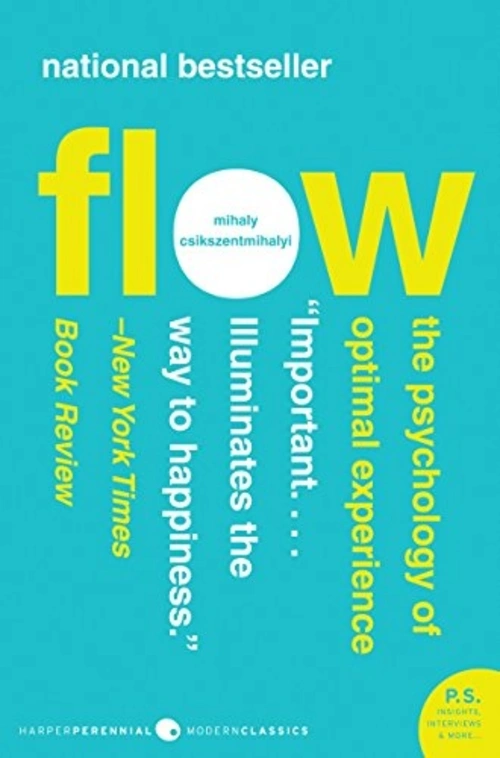
I had this book in my reading queue for a long time, but for whatever reasons I kept postponing reading it.
Even if the book is titled “flow”, the author intent is to use tools of modern psychology to explore when do people feel more happy. Flow was published on 2009, and due to its popularity its main ideas have become widespread. However, the book is still worth reading to fully understand Csikszentmihalyi point of view.
Happiness, according to Csikszentmihalyi, is not something that happens to us, but a condition that must be prepared for, cultivated, and defended privately by each person. The bottom line of happiness is how we feel about ourselves and about what happens to us.
Csikszentmihalyi defines flow as a state of complete absorption in an activity where you lose self-consciousness and sense of time. It occurs when you’re fully immersed in what you’re doing,
When a person experiences flow as often as possible, the quality of life improves. Even boring routines become purposeful and enjoyable. “In flow we are in control of our psychic energy, and everything we do adds order to consciousness.”
It is when we act freely, for the sake of the action itself rather than for ulterior motives, that we learn to become more than what we were. When we choose a goal and invest ourselves in it to the limits of our concentration, whatever we do will be enjoyable. And once we have tasted this joy, we will redouble our efforts to taste it again. This is the way the self grows. (p. 42)
Flow is important both because it makes the present instant more enjoyable, and because it builds the self-confidence that allows us to develop skills and make significant contributions to humankind.
One of the results of a flow experience is both differentiation and integration of the self, or a more complex organization of the self:
- Differentiation is the movement toward uniqueness and separating—differentiating—oneself from others.
- Integration is the union with other people, ideas, and entities beyond the self.
Family life in particular should be a source of flow experiences. Families should both be differentiated and integrated:
- each person is encouraged to develop his or her unique traits, maximize personal skills, set individual goals.
- what happens to one person affects all others.
Our relationship with other people—friendship—plays an important role. When we are young, friendship usually happens by circumstances. Later in life they must be cultivated.
Enjoyment
Pleasure, being a component of the quality of life, does not bring happiness by itself. It does not produce psychological growth, does not add complexity to the self, and by itself cannot create new order in consciousness.
Enjoyment, on the other hand, is characterized by a sense of novelty and accomplishment. An enjoyable event changes us, our self grows. We become more complex as a result of it.
While we can experience pleasure without any exerting any effort, enjoyment only happens as a result of unusual investments of attention.
According to the author, there are eight components of enjoyment:
- We confront ourselves with tasks we have a chance of completing.
- We must be able to concentrate on what we are doing.
- Concentration is usually possible because the task has clear goals.
- The task provides immediate feedback.
- One acts with a deep but effortless involvement that removes from awareness the worries and frustrations of everyday life.
- The experience allows us to exercise a sense of control over our actions.
- Concern for the self disappears, but paradoxically the sense emerges stronger once the flow experience is over.
- The sense of duration of time is altered. Hours pass by in minutes, and minutes can stretch out to seem like hours.
While there are exceptions, optimal experiences usually occur within sequences of activities that are goal-directed, that require the investment of psychic energy, and that could not be done without the appropriate skills. Activities that produce flow have rules that require learning of skills, set up goals, provide feedback, and make control possible.
Any activity contains a bundle of opportunities for action, or “challenges,” that require appropriate skills to realize. For those who don’t have the right skills, the activity is not challenging; it is simply meaningless.
Optimal experience becomes an end in itself (autotelic), even if it’s initially undertaken for other reasons, even if initially undertaken for other reasons (exotelic). The experience itself is the reward. Most things that we do are neither purely autotelic nor purely exotelic.
The flow experience, like everything else, is not “good” in an absolute sense. It is good only in that it has the potential to make life more rich, intense, and meaningful; it is good because it increases the strength and complexity of the self. But whether the consequence of any particular instance of flow is good in a larger sense needs to be discussed and evaluated in terms of more inclusive social criteria.
The Autotelic Personality
The “autotelic self” is one that easily translates potential threats into enjoyable challenges, and therefore maintains its inner harmony. A person who is never bored, seldom anxious, involved with what goes on, and in flow most of the time may be said to have an autotelic self.
People don’t have the same potential to control consciousness. The inability to control psychic energy can lead to difficulties with learning and experiencing true enjoyment.
Two kind of personalities in particular may find difficult to become interested in intrinsic goals, “to lose oneself in an activity that offers no rewards outside the interaction itself”, and thus enter a state of flow:
- People with excessive self-consciousness are constantly worried about how others will perceive them.
- Self-centered individuals may not be self-conscious, but evaluate information only in terms of how it fit their desires.
The social equivalents to attention disorder and self-centeredness are anomie and alienation. Anomie —the total lack of rules— corresponds to anxiety, while alienation corresponds to boredom.
Other people seem able to find meaning in what they do regardless of the circumstances, even in harsh conditions. They find strategies to regain control of their consciousness. Csikszentmihalyi calls them “the People of Flow”:
When adversity threatens to paralize us, we need to reassert control by finding a new direction in which to invest psychic energy.
The most important trait of these survivors is a “nonself-conscious individualism”, a strongly directed purpose that is not self-seeking. In contrast, people who are mainly concerned in protecting their self fall apart when the external conditions become adverse or threatening.
The Body in Flow
The easiest steps for improving the quality of life is by simply learning to control the body and its senses.
The body never produces flow by its movements alone. The mind is always involved. The most trivial physical activity can be profoundly enjoyable if a person sets goals and takes control of the process. “Enjoyment does not depend on what you do, but rather on how you do it.”
One cannot expect to take true enjoyment in a pursuit without cultivating the necessary skills.
Memory plays a crucial part in life. Every individual is a historian of his or her own personal experience. Remembering the past is instrumental in the creation and preservation of a personal identity.
The past can be never literally true in memory. It is continuously edited. The only question is whether we take creative control of the editing or not.
Knowledge that is seen to be controlled from the outside is acquired with reluctance, and it brings no joy. But as soon as a person decides which aspects of the past are compelling, and decides to pursue them, focusing on the sources and the details that are personally meaningful, and recording findings in a personal style, then learning history can become a full-fledged flow experience.
We also become philosophers of our own life by reflecting to our inner challenges:
To write down one’s insights expecting that someday they will be read with awe by posterity would be in most cases an act of hubris, that “overweening presumption” that has caused so much mischief in human affairs. But if one records ideas in response to an inner challenge to express clearly the major questions by which one feels confronted, and tries to sketch out answers that will help make sense of one’s experiences, then the amateur philosopher will have learned to derive enjoyment from one of the most difficult and rewarding tasks of life
Cheating Chaos
Three steps are involved in the transformation of a hopeless situation into a new flow activity that can be controlled:
- Unselfconscious self-assurance. There is an implicit belief that destiny is in one’s hands, while at the same time not being self-centered. The person doesn’t feel that their intentions take precedence over everything else, but instead feels part of whatever goes on around them.
- Focusing attention on the world. People who know how to transform stress into enjoyable challenge spend very little time thinking about themselves. The focus is still on the person’s goal, but it is open enough to notice and adapt to external events.
- The discovery of new solutions. There are two ways to cope with a situation that creates psychic entropy. The direct approach is to focus attention on the obstacles and try to move them away. The other approach is to focus on the entire situation, including oneself, and try to discover whether a different solution is possible.
Most of us become so rigidly fixed in the ruts carved out by genetic programming and social conditioning that we ignore the options of choosing any other course of action. Living.
The autotelic self transforms potentially entropic experience into flow.
To approach optimal experience as closely as is humanly possible, one must turn life into a unified flow experience.
If a person sets out to achieve a difficult enough goal, from which all other goals logically follow, and if he or she invests all energy in developing skills to reach that goal, then actions and feelings will be in harmony, and the separate parts of life will fit together—and each activity will “make sense” in the present, as well as in view of the past and of the future. In such a way, it is possible to give meaning to one’s entire life.
The simplest of the models for describing the emergence of meaning goes along a gradient of complexity:
- The need to preserve the self, to keep the body and its basic goals from disintegrating.
- The values of community, the family, the neighborhood, a religious or ethnic group.
- Reflective individualism, finding new grounds for authority and value within the self.
- Turning away from the self, toward an integration with other people and with universal values.
Inner conflict, which leads to chaos, is the result of competing claims on attention.
The only way to reduce conflict is by sorting out the essential claims from those that are not, and by arbitrating priorities among those that remain.
Activity and reflection should ideally complement and support each other. Action by itself is blind, reflection impotent.
Before investing energy in a goal, it’s worth asking:
- Is this something I want to do?
- Is this something I enjoy doing and I’m likely to enjoy in the foreseeable future?
- Is the price I and others will have to pay worth it? Can I live with myself if I accomplish it?
The catch is that these questions are almost impossible to answer for someone who has lost touch with his own experience. Someone not bothered to find out what he or she wants cannot plan action meaningfully. On the other hand, a person with a well-developed reflection habit, need not to go through a lot of soul-searching to decide whether a course of action is entropic or not.