Getting to Yes. Negotiating Agreement Without Giving In by Roger Fisher, William Ury, and Bruce Patton
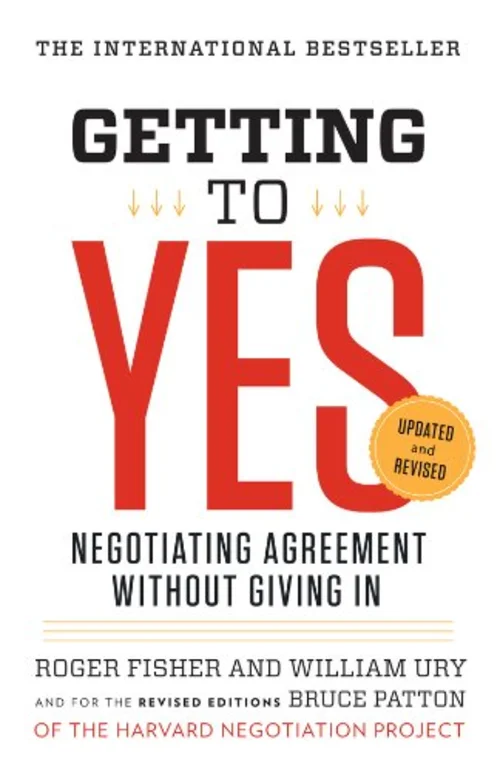
Getting to Yes is a book on Harvard’s method of Principled Negotiation: hard on the facts, soft on the people. It’s about deciding issues on their merits rather than through focusing on what each side says it will and won’t do.
People differ. Consciously or not, they use negotiation to handle their differences.
In contrast to positional negotiation, principled negotiation tries to achieve a wise and efficient agreement−if one is possible. A wise agreement is one that meets the legitimate interests of each side to the extent possible, resolves conflict early, is durable, and takes community interests into account.
The more attention paid to position, the less attention is paid to the underlying concerns of the parties.
Positional negotiation is inefficient. To improve your chances, you start with an extreme position and deceiving the other party as to your true views. You make concessions only as necessary to keep the negotiations going. A lot of small decisions must be made. There is little incentive to move quickly. It can quickly escalate into a contest of will. (The same is true for the other side, and gets worse if there are more than two sides.)
Also, arguing over positions endangers an ongoing relationship.
A third kind of negotiation, soft negotiation, emphasizes building and maintaining a relationship. The goal is agreement. You make concessions to cultivate the relationship. You search for the answer the other side will accept. It may be efficient, but the result may not be wise and runs the risk of producing a sloppy agreement. Also, it makes you vulnerable to someone who plays a hard game of positional bargaining.
The Principled Negotiation method involves four steps:
- Separate the people from the problem.
- Focus on interests, not positions.
- Invent options for mutual gain.
- Insist on using objective criteria.
What if the other side is more powerful?
Rather than only having a bottom line−which inhibits imagination and establishes a position that can be changed−you should think about your Best Alternative To a Negotiated Agreement (BATNA).
When you decide for a minimum price for your house, the question is what will you do if by a certain time you have not sold the house. The reason you negotiate is to produce something better than the results you can obtain without negotiating.
A BATNA is a better measure of what you want to get, and a better alternative to a bottom line. Not having thought carefully about what you will do if you don’t reach an agreement is like negotiating with your eyes closed. You would be lacking a standard to measure any proposed agreement.
Many times the danger is being too committed to reaching agreement. The better your BATNA, the greater your power. “The relative negotiating power of two parties depends primarily upon how attractive to each is the option of not reaching agreement.”
What if they won’t play?
What if the other side doesn’t want to focus on the merits? There are three basic approaches to this situation:
- Consider what you can do.
- Consider what they may do.
- Consdier what a third party can do.
Negotiation Jujitsu
If the other side pushes hard, you may be tempted to push back. But if you do, you’ll end up in the positioning bargaining game. Defending positions only lock both of you in.
Their attack, usually asserts their position, attacks your ideas, or attacks you.
Do not push back. Refuse to react. Sidestep their attack and deflect it against the problem. Treat their position as one possible option. “Look for the interests behind it, seek out the principles that it reflects, and think about ways to improve it.”
Assume every position they take is a genuine attempt to address the basic concerns of each side. Ask them how they think it addressees the problem at hand. Objectively examine the extent to which their position meets the interests of each party, or might be improved to do so.
Discuss the principles underlying the other side’s positions. Don’t defend your ideas. Invite criticism and advice.
Recast an attack on you as an attack on the problem. Use questions instead of statements. Statements generate resistance. Questions generate answers, pose challenges, and offer no target to strike. Or at least make them think.
Pause. Silence is one of your best weapons.
The One Text Procedure
This procedure is many times essential for large multilateral negotiations.
In the One-Text-Procedure, you ask a third party to listen to both sides and prepare a draft. Then, this third party asks both parties for criticism on the draft. Based on the criticism, a new draft is prepared and again presented for criticism. When the third party feels that there is no further room for improvement, he or she presents a final draft to both parties and says: “This is the best I can do. I have tried to reconcile your various interests the best that I could. (…) I recommend you accept this plan.” (p. 116)
No one is committed to the draft, so no ego is hurt. There is only one decision to make: yes or no.
The one-text procedure not only shifts the game away from positional bargaining, it greatly simplifies the process both of inventing options and of deciding jointly on one.
The catch, of course, is in choosing a wise third party.
What If They Use Dirty Tricks?
What if the other side is a hard bargainer? Their bag of tricks may range from lies and psychological abuse to various forms of pressure tactics, ranging from illegal or unethical to unpleasant.
People respond to tricky bargaining tactics either by putting up with it (most people), or by responding in kind. In both cases, you loose either by conceding when you should not, or by locking yourself into a position. (Or negotiation breaks off.)
To counter tricky tactics, you want to engage in meta-negotiations: a principled negotiation about the negotiating process itself.
Three basic steps to deal with hard negotiators:
- Recognize their tactic. You have to know what is going on to be able to do something about it. Often just this recognition will neutralize the tactic.
- Raise the issue explicitly. It makes the tactic less effective, and many times makes the other side stop using it.
- Question the legitimacy and desirability of the tactic. Negotiate over it. Focus on the procedure instead of the substance, so you can later produce a wise agreement over the substance.
Deliberate deception
A common tricky tactic is deliberate deception, that is, the misrepresentation about facts, authority or intentions.
Separate people from the problem. Unless you have good reason to trust somebody, don’t. This doesn’t mean calling the other party a liar. It means making negotiations proceed independent of trust. You should verify factual assertions.
- Ambiguous authority. The other side allows you to believe that they have full authority to compromise, when they actually don´t. What you think is an agreement was really a floor for further negotiation, because the terms of the other side need to be ratified by someone with actual authority.
Don´t assume the other side has authority. Ask about it explicitly. - Dubious intentions. When the issue is possible misrepresentation of their intention to comply with the agreement. You perceive that the other party will not execute on an agreement even if he explicitly said he will. In these situations, it is often possible to build compliance features into the agreement itself.
- Less than full disclosure is not the same as deception. Good faith negotiation does not require full disclosure.
Psychological warfare
These are tactics designed to make you feel uncomfortable, so that you’ll unconsciously want to end the negotiation as soon as possible.
- Stressful situations. Don´t dismiss apparently modest questions like where the meeting takes place. Be aware of the choice and the effects it may have. Too noisy rooms, temperature too hot or cold, no place for private discussions…
- Personal attacks. Verbal and nonverbal communication used to make you uncomfortable.
They can comment on your clothes or your appearance. “Looks like you were up all night. Things not going well at the office?” They can attack your status by making you wait for them or by interrupting the negotiations to deal with other people. They can imply that you are ignorant. They can refuse to listen to you and make you repeat yourself. They can deliberately refuse to make eye contact with you. (Simple experiments with students have confirmed the malaise many feel when this tactic is used, and they are unable to identify the cause of the problem.) In each case recognizing the tactic will help nullify its effect; bringing it up explicitly will probably prevent a recurrence.
- Good-guy/bad-guy. It’s a form of psychological manipulation. If you recognize it, you won´t be taken in. “When the good guy makes his pitch, just ask him the same question you asked the bad guy.”
- Threats. One of the most abused tactics in negotiations. They are easy to make, and you don’t have to actually carry them out. But they can spiral and destroy the negotiation. Good negotiators rarely resort to threats. Warnings are more legitimate than threats and are not vulnerable to counterthreats.
Positional pressure tactics
Designed to structure the situation so that only one side can effectively make concessions.
-
Refusal to negotiate. “I’ll see you in court.” (Variant: setting preconditions for negotiations.)
Recognize the tactic. Don´t attack them for refusing to negotiate. Talk about their refusal to negotiate. Communicate either directly or through third parties. Insist on using principles.
-
Extreme demands. The goal is to lower expectations. The expectation is that both parties will end up “splitting the difference”. The problem with extreme demands, besides that both parties know that they will be abandoned, is that it undermines your credibility.
-
Escalating demands. A negotiator raises one of his demands for every concession he makes on another.
Call it to their attention and take a break. Avoid an impulsive reaction while indicating the seriousness of their conduct.
-
Lock-in tactics. One party strengthens its bargaining position by weakening its control over the situation. (e.g,. committing in a public speech to something, so that the party loses face if they agrees to something else.)
Lock-in tactics are gambles. You can choose to interpret the commitment on weaker terms, or resist lock-ins on principle. In any case, avoid making the commitment a central question.
-
Hardhearted partner. “I personally would have no objection, but my boss…”
Again, recognize the tactic. Get the other party’s agreement to the principle involved. Try to speak with the “hardhearted partner”.
-
Calculated delay. When one party postpones coming to a decision until a time they think favorable. (e.g, waiting until a few hours before a deadline.)
In addition to making the tactic explicit and negotiating about them, create fading opportunities for the other side. (e.g., look for a second or third buyer.)
-
Take it or leave it.
As an alternative to explicitly recognizing the “Take it or leave it” tactic and negotiating about it, consider ignoring it at first. Keep talking as if you didn’t hear it, or change the subject, perhaps by introducing other solutions. If you do bring up the tactic specifically, let them know what they have to lose if no agreement is reached and look for a face-saving way, such as a change in circumstances, for them to get out of the situation.
The last part of the book is a recompilation of questions the authors have received since the first edition of Getting to Yes. They give full length answers and many examples.
All in all, a good read, and a good refresher about negotiation, even if the topic is not new to you.