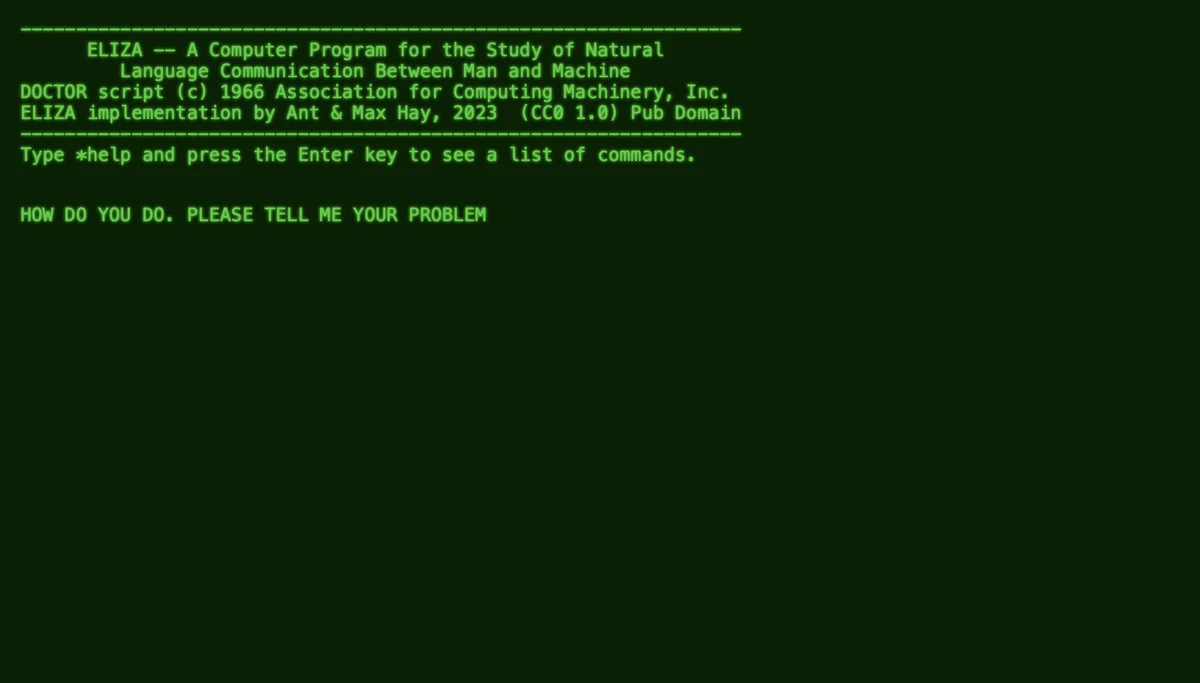
The ELIZA Effect
Thanks to Daring Fireball, I discovered the Eliza Archeology site.
As the site explains:
ELIZA is the original and highly influential chatbot that launched the genre of human-computer interactions using text-based agents. It was created at MIT in the 1960s as part of Project MAC by it’s designer and programmer, Joseph Weizenbaum. ELIZA not only allowed Weizenbaum to develop a mode of interaction with computers that is highly interactive, it also contributed to the way in which people were starting to conceptualize computers as having the capacity to usefully engage in conversation.
I came to know ELIZA from the great book More BASIC Computer Games, published by Creative Computing Magazine. The ELIZA version that came with the book was probably a simple adaptation, but I remember spending some time chatting with the program1.
The ELIZA Effect explains why many people are so engaged chatting with their favorite AI chatbot, and even why some people may think LLMs have some kind of consciousness:
The Eliza Effect is the propensity for humans to ascribe understanding and intelligence to computer systems. Hofstadter (1995: 167) described it as “the susceptibility of people to read far more understanding than is warranted into strings of symbols - especially words - strung together by computers”, a compelling description written in 1995 but which accurately describes generative AI systems today like ChatGPT. Similarly, Turkle described that “the Eliza effect refers to our more general tendency to treat responsive computer programs as more intelligent than they really are. Very small amounts of interactivity cause us to project our own complexity onto the undeserving object” (Turkle 1997: 101).
PS: You can try a web version of ELIZA.
-
…chatting with the program after typing the code from the book and fixing the typos. ↩︎