WWDC 2026: Apple doesn't sell AI. It sells features that use AI
Every year in June, Apple holds its World-Wide Developer Conference (WWDC). The event opens with Apple’s WWDC keynote, where Apple executives announce major technology improvements for the Apple ecosystem both in hardware and software.
As always, WWDC attracts expectations from both pundits and Apple geeks. Some things to note: John Ternus, Apple’s announced next CEO, didn’t appear on the pre-recorded video. Also, announcements were centered around software. No new hardware announced this time.
Improvements
Apple announced a series of platform improvements. Many were fixes to annoying problems with Apple’s Liquid Glass UI. Others were speed optimizations: faster upload of photos, or applications launching faster.
They also mentioned that Spotlight, Apple’s built-in system search feature for macOS, iOS, and iPadOS is going through a complete rearchitecture. “We’ve all had that moment when you search for something you know it’s there, but it won’t show up”. They omitted more interesting situations with Spotlight like “I’ve run out of disk space because Spotlight is building 400GB of index files”, or “I had to restore my device because Spotlight got corrupted and it was not fixable”.
Trust and safety features, aimed at families with kids, are getting an overhaul. The revamped Screen Time is a mix of things that were already there but didn’t work, and other new things for better device management.
While some media outlets are listing the improvements—uniform radius for window edges… wow!—, for those who understand AppleSpeak, this is Apple’s way of saying: We are sorry. There are many things that we made mistakes about or aren’t just working. We are trying to fix them. Tim Cook-era Apple doesn’t make mistakes. Ever.
Apple Intelligence
This section started with the announcement of Apple’s partnership with Google, thanks to which Google Gemini becomes part of Apple foundation models. Most important, it will be part of the machinery powering Siri AI, the new version of Siri.
Apple made it clear that Apple Intelligence is not Google’s Gemini, but uses Gemini among other local and server-based AI models. Apple’s doctrine is to control the core technologies behind their products. So adopting Gemini instead of an Apple proprietary LLM says a lot about what Apple proprietary models can actually achieve. That is, probably not much at this point. More AppleSpeak: the partnership with Google, and Gemini, were mentioned only once during the whole keynote.
The announcements around Apple Intelligence show promise. In this new iteration, Apple Intelligence will be integrating system-wide, with new system orchestration and personal context understanding. This allows functionality like finding something just by asking, understanding on-screen context, and the ability to orchestrating agent-like behavior.
These features are not revolutionary. They were promised by Apple a couple of years ago but never shipped. Alas, similar features were promised by Google and they still aren’t fully functional.
Some years ago, my kids could ask Siri for a song while we were in the car. This feature no longer works reliably. And please don’t try to get Siri to schedule a meeting. Even taking a voice note in Apple Notes using Siri is unreliable for me.
If the new Siri AI delivers what’s promised, I’m sure the whole iPhone ecosystem will get a huge boost, because it’s at the integration of AI with the device where AI becomes really useful and mainstream.
Will my devices be able to use Apple Intelligence?
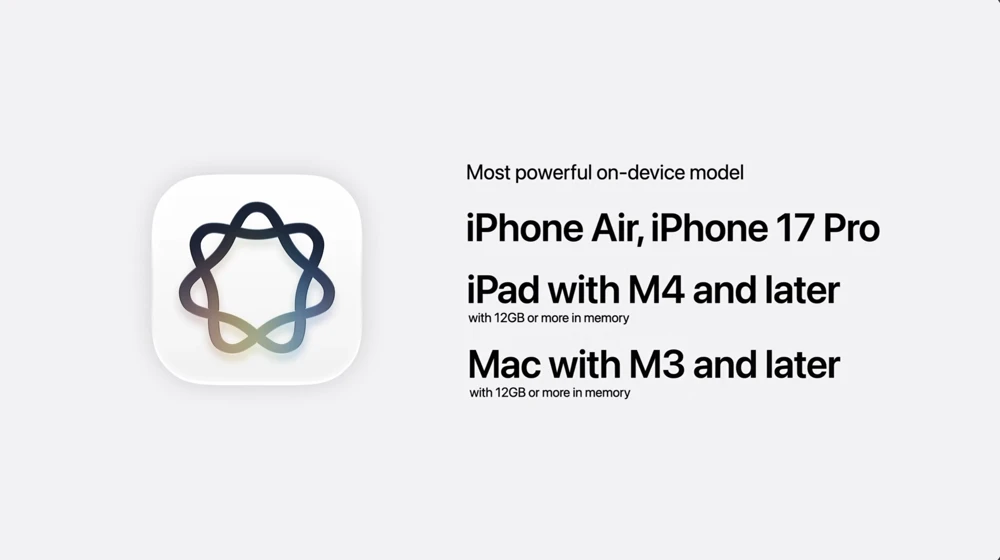
When Apple first announced Apple Intelligence in 2024’s WWDC, it also announced that it would only run on the iPhone 15 Pro and Pro Max, and iPads and Macs with Apple’s M1 Silicon or later. Today’s Apple Intelligence advanced features, which implements what was announced in 2024, will only run on the iPhone Air, iPhone 17 Pro, iPads with Apple M4 Silicon and later, and Macs with M3 and later.
This is a signal of what miserable state Apple Intelligence was in when it was first announced two years ago as “shipping next Fall.” This is also a signal of that integrating AI system-wide is not a trivial task.
OpenAI and Anthropic will compete with Apple for consumer subscriptions
Apple showed lots of AI use-cases during the keynote. I was wondering if Apple would give those features for free, or as a paid service. And then, at the end of the Apple Intelligence section, they casually mentioned that many features would be included, others would have daily usage limits, and that you would be able to pay for premium features and additional usage.
Paying Apple means that you’ll pay through the already familiar Apple Pay ecosystem and Apple subscription model.
The huge majority of people in the Apple ecosystem don’t pay OpenAI or Anthropic for AI. These companies sell AI-powered chatbots and APIs. Apple, however, is selling features that use AI. So, for the non-geeky Apple user, paying for enhanced photo editing—powered by Apple Intelligence—will be as natural as paying for additional iCloud space, Apple Music or TV+.
If Apple succeeds at doing a great integration of AI system-wide, the it will have a solid advantage over both Android-powered devices and will lead the usage of AI for everyday tasks. OpenAI and Anthropic will remain offerings for heavy users, developers, and corporate environments.
I’ve been an Apple user for a long time, but in recent years I feel that Apple’s polished experience and attention to detail has fallen behind. WWDC is like Christmas: that time of the year when kids suspend disbelief and hope for the best when opening their presents. I really hope Apple delivers on its promises this time.
(Watch the full keynote: Apple WWDC 2026)